Introduction to Web Development Trends in 2026
The web development landscape changes rapidly. What was cutting-edge two years ago becomes outdated today. What seems new now will be standard in 2026. Staying ahead of web development trends is essential for developers, technology leaders, and business owners who want to build solutions that are competitive and future-proof.
Web development trends shape how applications are built, how they perform, and what capabilities they offer. Understanding these trends helps you make informed decisions about technology choices, architecture decisions, and investment priorities.
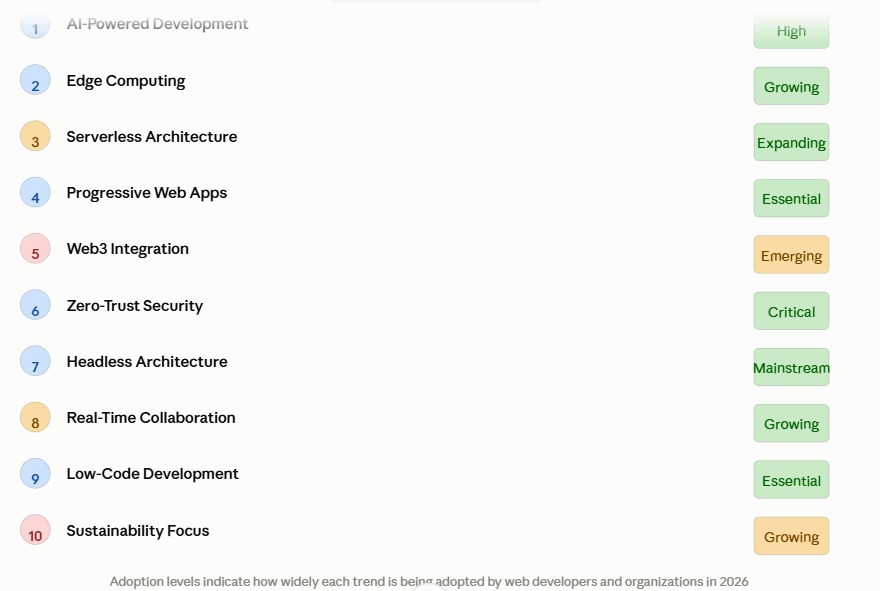
The web development trends dominating 2026 reflect fundamental shifts in how technology works. Artificial intelligence is becoming embedded in development tools and applications. Security has become paramount with zero-trust approaches. Performance and sustainability matter more than ever. And the ability to build quickly and scale efficiently drives architectural decisions.
In this comprehensive guide, we will explore the ten most significant web development trends that will dominate 2026. We will explain what each trend is, why it matters, and how it impacts development decisions. By understanding these web development trends, you will be better positioned to build applications that meet the needs of today and tomorrow.
Table of Contents
1. AI-Powered Web Development Tools
The first major web development trend in 2026 is the emergence of AI-powered development tools that fundamentally change how developers work.
Artificial intelligence is transforming web development from code generation to debugging, testing, and optimization. Tools like GitHub Copilot, which uses machine learning to suggest code, have evolved dramatically. In 2026, AI assistants do not just suggest code. They understand your entire project and provide intelligent recommendations across the full development lifecycle.
AI-powered tools now handle routine coding tasks automatically. They generate boilerplate code, write tests, and even refactor existing code for performance. This frees developers to focus on high-level architecture and complex problem-solving rather than repetitive coding tasks.
Beyond code generation, AI improves development productivity in multiple ways. AI tools analyze your codebase to identify security vulnerabilities, performance bottlenecks, and potential bugs before they reach production. Machine learning models predict which parts of your application are most likely to have issues based on patterns in your code.
For web development teams, AI-powered tools increase productivity and reduce manual work. Developers spend less time on routine tasks and more time on innovation. This makes teams more efficient and allows them to deliver features faster.
The web development trends around AI are also changing how developers learn and develop expertise. Instead of memorizing syntax and APIs, developers focus on understanding algorithms, architecture, and problem-solving. This shifts the skillset required for web development toward higher-level thinking.
2. Edge Computing Reshapes Application Architecture
Edge computing is the second major web development trend transforming how applications are built and deployed.
Traditional web development centralizes computation on servers in data centers. Users send requests to centralized servers, which process the request and return a response. This architecture has limitations. Network latency adds delays. Geographic distance creates performance issues for global users.
Edge computing moves computation closer to users. Instead of processing requests in a central location, code runs on edge servers distributed geographically around the world. This dramatically reduces latency and improves performance, especially for users far from centralized data centers.
Edge computing platforms like Cloudflare Workers, Vercel Edge Functions, and AWS Lambda@Edge enable web development teams to deploy code globally without managing infrastructure. Write once, deploy everywhere. Your code runs on the edge server closest to each user automatically.
For web development teams, edge computing enables new possibilities. You can serve dynamic, personalized content at CDN speeds. You can implement complex business logic at the edge instead of on origin servers. You can respond to user requests faster than was previously possible.
The web development trends around edge computing also involve managing complexity. Edge computing adds new architectural considerations. You need to think about data consistency across edge locations. You need to manage state efficiently at the edge. These architectural challenges drive new patterns and best practices for web development.
3. Serverless Architecture Becomes the Default
Serverless architecture represents the third major web development trend in 2026.
Serverless does not mean no servers. Rather, it means developers do not manage servers. Instead of provisioning and managing servers, you write functions that execute in response to events. The cloud provider handles scaling, availability, and infrastructure.
In 2026, serverless has matured significantly. Early concerns about cold starts, debugging, and observability have been addressed. Serverless platforms now offer warm starts that eliminate cold start delays. Debugging and monitoring tools have improved dramatically. Most importantly, serverless has become the default architecture for many applications.
Web development trends toward serverless reflect practical benefits. Serverless scales automatically from zero to millions of requests. You pay only for compute time used, not for idle capacity. This makes serverless cost-effective for variable workloads. Deployment is simple. There is no infrastructure to manage.
For development teams, serverless enables faster iteration. Deploy a new version of your function with a single command. Rollback if something breaks. No complex deployment processes. This encourages rapid iteration and testing in production.
The web development trends around serverless also involve architectural patterns. Microservices become natural. Each function is a small, focused piece of logic. Functions compose together to build larger applications. This architecture pattern is becoming standard for web development teams building scalable applications.
4. Progressive Web Apps Become Essential
Progressive Web Apps represent the fourth major web development trend in 2026.
A Progressive Web App is a web application that works like a native mobile app. Users can install a PWA on their home screen and launch it like an app. PWAs work offline, send push notifications, and access device hardware capabilities through browser APIs.
In 2026, Progressive Web Apps have transitioned from innovative to essential. Major organizations are building PWAs as their primary mobile strategy. Users increasingly expect web applications to work like native apps.
The web development trends toward PWAs reflect practical advantages. Building a single PWA is cheaper than building separate native apps for iOS and Android. A PWA works on any device with a modern browser. Updates deploy instantly without app store reviews. Users get a native app-like experience with lower development costs.
For web development teams, PWAs enable delivering app experiences without the complexity of native development. The technical barriers to building PWAs have lowered. Web APIs for offline storage, push notifications, and hardware access have matured. Tools and frameworks make it easier to build PWAs.
The web development trends around PWAs are also driven by user expectations. Mobile users expect offline functionality, fast performance, and home screen installation. Progressive Web Apps deliver all of this. For many applications, a well-built PWA delivers better user experience than native apps at a fraction of the cost.
5. Web3 Integration Emerges for Specific Use Cases
Web3 integration represents the fifth web development trend emerging in 2026, though with more measured adoption than in previous years.
Web3 refers to decentralized web technologies built on blockchain. This includes cryptocurrencies, NFTs, decentralized finance, and decentralized autonomous organizations. The initial hype around Web3 has subsided, but genuine use cases continue to emerge.
In 2026, web development trends around Web3 are more realistic. Rather than every application needing blockchain, specific use cases benefit from decentralized technologies. Financial applications benefit from blockchain settlement layers. Content platforms benefit from tokenization of creator value. Gaming and collectibles benefit from blockchain-based ownership.
For web development teams, Web3 integration means understanding blockchain technologies, smart contracts, and decentralized protocols. Web development teams that ignore Web3 miss opportunities in specific domains. Web development teams that understand Web3 can build innovative applications in finance, content, and gaming.
The web development trends around Web3 also involve tooling and infrastructure improving. Blockchain interaction has become easier. Libraries and frameworks abstract away complexity. Gas fees and scaling solutions have improved. These improvements make it feasible for web development teams to integrate blockchain without becoming blockchain experts.
6. Zero-Trust Security Becomes Non-Negotiable
Zero-trust security represents the sixth major web development trend in 2026.
Traditional security assumes that everything inside your organization is trustworthy and everything outside is not. This perimeter-based security model has proven inadequate. Once an attacker penetrates the perimeter, they have access to everything.
Zero-trust security assumes nothing is trustworthy by default. Every request must be authenticated and authorized. Every device must be verified. Every user must provide proof of identity. This shift from perimeter security to zero-trust fundamentally changes security architecture.
In 2026, web development trends strongly favor zero-trust approaches. Organizations are implementing zero-trust principles for security. Web development teams must design applications with zero-trust architecture from the start rather than adding security afterward.
For web development teams, zero-trust means building authentication, authorization, and verification into every application layer. You cannot rely on network security or implicit trust. Every API call must verify identity and authorization. Every device must be authenticated.
The web development trends around zero-trust security drive adoption of specific technologies. OAuth and OpenID Connect provide standardized authentication. Role-based access control and attribute-based access control provide authorization. API gateways and service mesh technologies enforce policies. Web development teams must understand these technologies and integrate them into applications.
7. Headless Architecture Becomes Mainstream
Headless architecture represents the seventh major web development trend becoming mainstream in 2026.
Traditional web development tightly couples the presentation layer (frontend) with the business logic layer (backend). Headless architecture decouples them. The backend provides an API. The frontend calls that API. The same API can power multiple frontends: web, mobile, voice, or any other interface.
In 2026, headless architecture has moved from cutting-edge to mainstream. Most new projects adopt headless architecture by default. Organizations recognize that decoupling frontends and backends provides flexibility and scalability.
For web development teams, headless architecture enables specialization. Backend developers focus on APIs and business logic. Frontend developers focus on user interfaces and experience. Teams can move at different paces and use different technology stacks.
The web development trends around headless architecture involve specific technology choices. REST and GraphQL provide API communication. Content management systems like Contentful provide headless CMS platforms. API-first development becomes the norm.
Headless architecture also enables content reuse. The same content served by the same API powers multiple frontends. A blog post written once can appear on your website, mobile app, email, and social media seamlessly. This efficiency drives adoption of headless architecture.
8. Real-Time Collaboration Features Become Standard
Real-time collaboration represents the eighth web development trend becoming standard in 2026.
Real-time collaboration allows multiple users to work on the same content simultaneously and see changes instantly. Google Docs pioneered this. In 2026, real-time collaboration is becoming expected in many application categories.
Web development tools like VS Code enable real-time collaborative coding. Project management tools enable real-time task collaboration. Design tools enable real-time design collaboration. Spreadsheet and document tools enable real-time data collaboration.
For web development teams, building real-time collaboration features is becoming essential for certain application types. Users expect to collaborate in real-time. Applications without real-time collaboration feel outdated.
The web development trends around real-time collaboration involve specific technologies. WebSockets provide real-time bidirectional communication. Operational transformation and conflict-free replicated data types handle concurrent editing. Cloud databases sync data instantly across users.
Implementing real-time collaboration adds complexity. You must handle network latency, offline scenarios, and conflict resolution. You must design UX that clearly shows what other users are doing. Despite the complexity, user expectations drive adoption of real-time collaboration features.
9. Low-Code Development Accelerates Time to Market
Low-code development represents the ninth major web development trend in 2026.
Low-code platforms enable building applications with minimal hand-coded programming. Visual interfaces, drag-and-drop components, and configuration replace traditional coding for many tasks. Low-code platforms accelerate development for standard application types.
In 2026, low-code platforms have matured significantly. They handle complex business logic, not just simple workflows. They integrate with existing systems. They enable professional developers to be more productive alongside business users building simple automation.
For development teams, low-code platforms accelerate certain types of projects. Building a data entry application? Use low-code. Building workflow automation? Use low-code. Building custom business logic that requires specialized knowledge? Traditional development might still be better.
The web development trends around low-code reflect pragmatic choices. Not every application needs sophisticated architecture. Not every developer enjoys writing the same boilerplate code repeatedly. Low-code enables focusing development effort where it matters most: custom business logic and user experience.
However, low-code has limitations. Complex applications still require traditional development. Integrating low-code and traditional development creates skills challenges. Web development teams must understand both approaches.
10. Sustainability Becomes a Web Development Priority
Sustainability represents the tenth major web development trend gaining importance in 2026.
Web development consumes energy. Data centers consume electricity. Inefficient code consumes more electricity. As environmental concerns increase, web development teams face pressure to reduce energy consumption and carbon footprint.
In 2026, web development trends increasingly emphasize sustainability. Green web development practices focus on reducing energy consumption. Efficient code, optimized assets, and fast page loads reduce energy use. Hosting on renewable energy sources reduces carbon footprint.
For web development teams, sustainability means considering energy consumption as a design constraint. Fast, efficient code is not just good for users. It is good for the planet. Tools now measure and report the environmental impact of web applications. Organizations track carbon footprint like they track performance metrics.
The web development trends around sustainability also involve hardware choices. Sustainable hosting providers use renewable energy. CDNs position content geographically to reduce transmission distances. Efficient code reduces computational load on servers.
Sustainability in web development is not just environmental responsibility. It is good business. Efficient applications cost less to run. Fast applications convert better. Sustainable practices improve business metrics while reducing environmental impact.
How Web Development Trends Affect Business Decisions
Understanding web development trends is not just for developers. Business leaders and product managers must understand these trends because they affect strategic decisions.
The web development trends we have discussed require investment in new technologies and skills. Your development team must learn new tools, new architectures, and new approaches. Training and hiring become important investments.
These web development trends also affect timeline and budget. Adopting new technologies adds complexity and risk initially. Teams experience a learning curve. Initially, productivity may decrease as teams learn new approaches. Over time, productivity increases as teams master new technologies.
The web development trends also affect competitive positioning. Organizations that adopt new trends quickly gain competitive advantages. They can build applications faster and deliver features users want sooner. Organizations that lag behind in adopting web development trends lose competitive ground.
The Reality of Web Development Trends
Web development trends are not all simultaneously important for every organization. Different trends matter differently depending on your specific needs.
A mobile-first gaming company might prioritize real-time collaboration and low-code for analytics dashboards. An enterprise software company might prioritize zero-trust security and headless architecture. A startup might prioritize serverless architecture and AI-powered development tools to move fast with limited resources.
The web development trends to adopt depend on your business context. Adopting all trends simultaneously is neither feasible nor desirable. Successful organizations carefully evaluate each trend and adopt the ones that create business value for their specific situation.
Preparing for Web Development Trends in 2026
How should organizations prepare for web development trends in 2026?
Start by understanding your current technology stack and architecture. Where are the pain points? Which trends address those pain points? Prioritize adopting trends that solve real problems.
Invest in your team. Web development trends require learning and experimentation. Allocate time and resources for professional development. Encourage your team to explore new technologies through side projects and experimentation.
Build gradually rather than replacing everything at once. Adopt new technologies incrementally. Integrate new approaches into new projects before fully committing. Learn before you fully transform.
Partner with experienced technology partners who understand these web development trends. Consultants and development partners bring expertise and experience accelerating adoption of new technologies.
Damisrael Technologies: Navigating Web Development Trends
At Damisrael Technologies, we specialize in technology and product development. We understand web development trends deeply and help organizations adopt them strategically.
We have expertise across all the major web development trends we have discussed. Our team has built serverless applications, Progressive Web Apps, headless systems, and real-time collaborative features. We understand the tradeoffs and challenges of each approach.
More importantly, we understand that not every trend is right for every organization. We evaluate your specific needs, your team’s capabilities, and your business goals. We recommend a strategic technology approach that combines proven technologies with selective adoption of new trends.
Whether you are building a new application from scratch or modernizing an existing system, our team helps you navigate web development trends and build solutions that are competitive and future-proof.
Getting Started With Modern Web Development
If you are concerned that your current technology stack is falling behind web development trends, now is the time to act.
Start by assessing your current state. What technologies are you using? What capabilities do you have? What pain points are you experiencing? This assessment guides your modernization strategy.
Next, prioritize. Which web development trends address your biggest pain points? Where can you get quick wins? What foundational work needs to happen first?
Then execute gradually. Pilot new approaches on new projects before full commitment. Build team expertise through training and mentoring. Learn from experience before scaling.
Finally, measure results. How do these web development trends affect your business metrics? Are applications faster? Are teams more productive? Is time to market shorter? Use business metrics to validate your technology investments.
Web Development Trends and Your Technology Roadmap
Your technology roadmap should reflect web development trends while staying grounded in your business reality.
In 2026, competitive web applications leverage cloud technologies, serverless architecture, edge computing, and AI-powered tools. They prioritize security with zero-trust approaches. They enable real-time collaboration. They are built rapidly using low-code platforms where appropriate.
Your roadmap should move you toward this modern technology landscape, but not overnight. Gradual adoption, combined with strategic partnerships, gets you to the future state without disruption.
At Damisrael Technologies, we help you develop a realistic technology roadmap that keeps you competitive while managing risk and investment appropriately.
Ready to Adopt Web Development Trends?
Web development trends in 2026 represent significant opportunities to build better applications, improve team productivity, and compete effectively in your market.
Whether you are starting from scratch or modernizing an existing system, understanding and adopting these web development trends strategically positions you for success.
Contact Damisrael Technologies today to discuss how these web development trends apply to your specific situation. Our team will help you evaluate options, plan your modernization strategy, and execute effectively.
Services That Support Modern Web Development
- Custom web application development using modern technologies
- Serverless and cloud-native architecture design
- Progressive Web App development
- Headless CMS implementation and integration
- AI-powered development tools integration
- Edge computing solutions
- Real-time collaboration feature development
- Security-first application architecture
- Full-stack technology strategy and consulting
Additional Resources
- GitHub Copilot Documentation for AI-powered development
- Cloudflare Workers for edge computing solutions
- AWS Lambda and Serverless Architecture patterns
- MDN Web Docs on Progressive Web Apps
- OWASP Zero Trust Architecture guide
- Vercel Edge Functions documentation
- GraphQL Foundation resources
- WebSocket and real-time communication patterns
About Damisrael Technologies
Damisrael Technologies is a technology and product development company serving startups, SMEs, and organizations worldwide. We help you build applications using modern web development technologies and approaches that drive business growth.